
I always loved the thriller genre, just like science-fiction. And if a movie, set in a contemporary age or everyday life, also contains some slightly surrealistic elements, like David Fincher's Se7en, it definitely hits my nerves.
In 1995, at thirteen, I was already obsessed with movies and the things I heard about this one were mainly negative or disturbed. Some described it as the most brutal and gory film ever, only comparable to Silence of the lambs (1991). I also remember then young, rising star Brad Pitt, setting a new male fashion style with his short hair and beard, right after his appearance in Legends of the fall (1994). I didn't read so much of the professional reviews back then. I'm sure their tone was different and far more praising. Today, the movie has definitely reached its well deserved cult status.
I think one of the reasons why I'm so fascinated by that (serial killer) genre is the spatial situation of the movies. Cities, towns, villages, or even some small rooms, it's the closed cosmos in which the stories very often take place. Mostly urban space, clear or not, claustrophobic, in any case closed or at least somehow defined. It's very often about an invasion of privacy and everyday routine (within this closed cosmos) and the actions and reactions of perpetuator and victim. The authorities, the police force usually find themselves somewhere between these two. They struggle and try to solve the case, chasing the murderer or protecting somebody. They also have to "play" the game within the limited (urban) space and although they should dominate it with guns and badges, they often face a criminal who knows to rule it better than they do. This limited urban environment, including its dark, secret corners and threats, its mazes, but also its beauty and almost organic, architectural life fascinates me again and again.
Se7en is like a prototype of this urban constellation. Not the first one at all, but an extremely effective one, in my opinion.
This movie is my personal favorite thriller (among Silence of the Lambs) because every detail and every aspect of it seems to fit together perfectly.
You can really feel Fincher's will to do everything right, choose the perfect professional crew, the right actors and watch every single detail of the production design, the cinematography, the editing, the score. Delivering a remarkable, unique masterpiece which is technically and emotionally convincing. In one word: the perfect motion picture, achieved by just doing everything right and in his (Fincher's) own way.
Maybe I'm exaggerating a little bit. But I wouldn't be surprised if then 33 year old David Fincher, who was quiet frustrated because of the producers who nearly ended his production of Alien III (1992, as he often described in interviews) was strongly determined to realize his very own vision of a theatrical movie, without any interferences from outside or the studio. And in my opinion, he succeeded.
The story
The movie's basic storyline is truly simple. Detective William Somerset is about to retire in seven days. Detective David Mills just moved into the city with his wife and becomes Somerset's new partner. Somerset is a very experienced, wise, but also resigned and cynical cop who lives alone. Mills is almost a rookie who's doing his job, but gets annoyed by Somerset's own methods and reluctant attitude very soon.
Together they investigate a series of extremely cruel murders, which seem to be connected with religious mythologies and rituals. Somerset also meets Mills' wife who doesn't feel comfortable at all in this (nameless) city and she tells him about her pregnancy which David doesn't know about.
Later, as they encounter the perpetrator (calling him simply John Doe) and chase him, he escapes and remains unknown. They search his apartment and get involved deeper and deeper into the bloody-minded, apocalyptic game the mysterious murderer is playing with them.

The present in the past in the present
During the movie. the present and the past "collide" in many different ways, often visible through its design and environment.
Looking at the rooms, police offices and its interior objects (excluding John Doe's apartment and some of the victim's places), most people wouldn't notice anything very special about it. But when I checked it again after a very long time, I could literally smell the frowsty sent of old police offices and desks, right out of the american 40ier and 50ies film noir era. Indeed, the movie seems to be basically set in the mid 90ies present, nevertheless a lot of its ambience refers to that film-noir era. Like the furniture, chairs, doors or the faces of the buildings.
On the other hand, following Somerset and Mills doing their research, you feel like roped directly into this city's deepest hell. I think the word "moloch" is the only word that can really describe Fincher's vision of the modern, rotten, surrealistic and apocalyptic city of western civilization without a specific name. Starting with the first victim's apartment, a very dark, creepy place (even some ants are visible), the look of the further crime scenes gets even more bloody and chaotic, but never in a cheap way or just gory.
When the cops enter John Doe's apartment, you feel like stepping into the (urban) heart of darkness. And again, its doors and objects (partly painted black) remind me of some old buildings, probably from the 40ies or 50ies, ready to be pulled down. The apartment seems quiet big, but all the black and dark walls, lighten up by a lot of smaller red light sources and the police' flashlights, make it seem much tighter and claustrophobic. Finally, Somerset discovers a room, filled with hundreds of notebooks and diaries, containing Doe's whole past thoughts and endless lines of notes which evoke the past-like feelings again, by written words. Doe even preserved some "souvenirs" from his victims, a cut-off hand in a water glass and - another important source of past events and elements - a lot of self-developed photographs. These pictures are especially shocking, because they not only show the victims, it seems that Doe works as (fake) newspaper photographer as well and took pictures of Mills who remembers him as such. Somerset and Mills realize that they let him go without even recognizing the killer. The photos, partly found in a bathtub, surrounded by red lab light, reflect a lot about the cinematic process of catching memories and time itself and also resume the previous murders. The discovery of Doe's apartment and its revealing content marks a climax and ending point of the cops' research, leaving them even more hopeless.
In general, Se7en contains a lot of hidden reflexions and connections between present and past. The setting and decor is one thing, but the spaces and timelines are also corresponding to the elements of present and past.
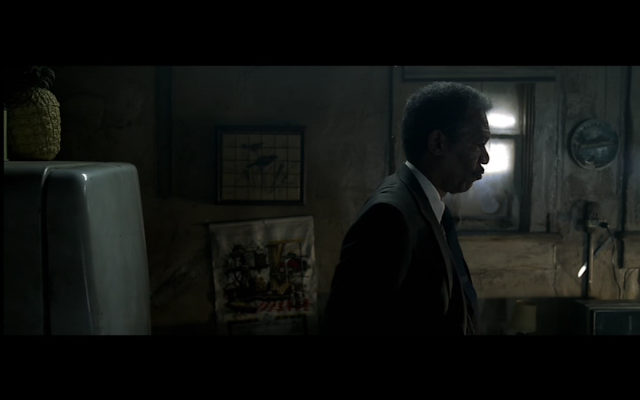
The first shot of the film presents us Somerset standing in his kitchen. We follow him through crime scene after crime scene, meeting Mills, Mills' apartment, offices, libraries, street chases, dark city life. Towards the end of the movie, Mills and Somerset are lead completely outside the city and "civilization", into the raw desert. The final showdown takes place there, the exact opposite of Doe's "heart of darkness", but nevertheless, this place is also ruled by him, in another way.
Mills' and Somerset's costumes, weapons, their police car and a police helicopter are the only city-like elements that make it into the desert. The rest of the giant, dirty, architectural moloch disappeared, and Doe and the two policemen bring the story to an end. When Doe's talking, resuming the previous murders, sitting on the dusty, hard desert ground, you can really feel the horror of the story, through cinematography, language and the environment - the production design.




The horror
As I pointed out, it's the whole environment, the places, apartments, offices and inhuman city image that evokes the uncertain atmosphere, the subtle horror. All these elements are actually very omnipresent in the movie, nevertheless, the bloody crime scenes, John Doe's sadistic thoughts (and direct and "ordinary" way to speak about it) and the physical violence seem to be more impressive to the general audience.
In a way, the scheme of horror in Se7en is quiet the contrary to Minority Report (my previous post). In Spielberg's futuristic thriller, the Sci-fi elements and its plain, shiny surfaces almost overweight the sporadic moments of dark horror and uncertain feelings that can overcome you while watching it. Se7en creates this uncertain, dark mood right from the beginning till the end (through architecture, the setting, the set design elements) and peaks it with blood and violent acts that shock us. But both movies also deliver the right mixture of all these elements to set the perfect tone.


The city
I already told a lot about the film's actual main character: the city. Its name is never mentioned. The fact that the showdown takes place in the desert, seemingly not far away from it, implies that it could be located somewhere in california or the southwest, but it's not certain. David Fincher, director of cinematography Darius Khondji and veteran production designer Arthur Max present us a living hell - dark, cruel, bloody, wet, dusty, sad, lonely. And filled with an atmosphere of constant uncertainty. Even the most ordinary places like coffee shops, restaurants or libraries seem creepy and as kind of hideouts for the citizens. The production design contains a lot of visible and almost invisible details and elements which refer to the past film-noir thrillers (as I wrote about before) and at the same time, the colors seem modern and moderate.
"Apocalyptic" is quiet the right expression for this nameless city. The mood in Ridley Scott's Blade Runner (1982) is an obvious example for Se7en, but nevertheless, the cops' antagonist, serial killer John Doe is the essential "center" of the city, even the whole movie. It almost seems to be "his" city, filled with people who fit exactly to the way he describes them (in his hundreds of notebooks) and when Somerset and Mills search his flat, they really dig into the deepest darkness of the city's structure and also spotting the sinister red shining cross over Doe's bed.
Somehow the film's cityscape looks to me like a accretion of all the social and economical fears of modern society.
Its dark sides, the people's aggressive feelings and the (exaggerated) anonymity, everything becomes manifest in the walls, streets and rooms of the world in Se7en. Especially the city's anonymity is terrifying and always present. If it's pouring in rain in any city, only few people don't try to escape from it. Rain clears the streets immediately and permanently, and even a murder could take place on the sidewalk, no one of the citizens in this movie really seems to care or notice.


William Somerset's apartment
Somerset is an old fashioned man. Being a police officer in this city since decades, living alone, and confronted with his near retirement.
His apartment matches its resident perfectly. It's almost looks a little bit like a caricature when rooms, objects and color tones reflect Somerset's live and mood. Vintage, washed-out, a bit dusty and dark furniture dominate the place. Some of Somerset's typical "tools" (similar to the ones he uses during work: a pocket knife, badge, characteristic hat, coat, etc.) are the darts board, his alarm clock on the bed table, and the metronome. They're essential parts of his everyday routine and introduced right at the beginning of the film. You could easily see the metronome as the story's metaphysical internal clock: slow, but permanent and somehow merciless. It also reflects Somerset's character and rhythm of life better than any other object or aspect in the film's production design.
The darts game, for which he uses his jack-knife, represents some kind of private exercise for him, sharp bladed, but only simulating real danger. Somerset appears as the classical film-noir detective: investigating, sharp-minded, experienced, old fashioned. But also cynic, lonely and rarely talking about his cloudy, not very happy past. By playing darts (always alone) he also seems to rehabilitate himself after professional or emotional throwbacks.
The very first shot of the movie shows Somerset in his kitchen, surrounded by the noise of traffic and city life outside his window. You never really see where his apartment is located within the city, but it's obvious that the urban, "modern" world has taken over around his old fashioned interior. This first image illustrates the basic mood of the film (followed by the metronome) in a simple, but very effective and subtle way.
After all these characteristics of Somerset's life, perhaps the saddest one closes the first glimpse at the movie (right before the famous opening credits sequence starts): showing the old cop lying in his bed, almost resembles a dead man's final moment. Right before the story even begins.
David and Tracy Mill's apartment
Somerset's new partner is a young cop, hotheaded, but with not too much experience in the field. Being in his late twenties or early thirties, married to Tracy, they just moved into the city. He's one of the guys who separate their private lives from the professional ones (one of the very few things he and Somerset have in common) and just because of that, he's very surprised (and not very amused) about Tracy inviting Somerset to their home. Fractiously, he introduces him to Tracy, followed by the dinner they have together.
The Mills apartment seems bigger than Somerset's and a lot brighter.
Big posters and pictures cover a part of the walls, unpacked boxes, filled with some stuff are still visible in the corners, and smooth jazz music is playing in the background. Mills is also welcomed by their dogs in another room, while Tracy prepares dinner. Somerset is having a look around (and almost seems like decent, silent visitor from another world) with the eyes of an investigator who steps into this very "young" and dynamic atmosphere of his partner's place.
Even today, seventeen years later, the Mills interior looks quiet modern and fashionable to me. Bright light, some second hand furniture and objects, classic art posters, elegant glasses of wine and the mentioned jazz sound complete the image of the young couple.
Nevertheless, the basic color tones match the dark city and even Somerset's rooms. The modern setting and lighting contrasts most of the rest of the production design, but it also completes it in a specific way.



The library
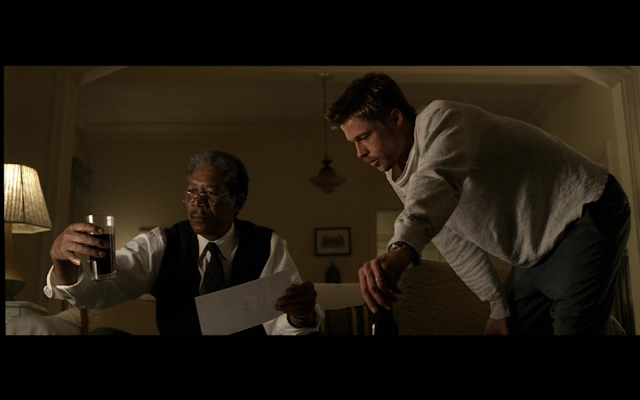
At one point of the story, Somerset wants to know more about the religious background and christian fanaticism of the serial killer. He starts to do some research in a city library, which he doesn't seem to visit for the first time. Somerset greets the small group of familiar cops (playing cards during their night shift upstairs) and begins to look for possible books and sources.
The giant, dark halls, filled with thousands of books in the shelves, is portrayed as an almost sacral place. Ideal for someone who wants to escape the noisy, dirty streets, looking for peace, space and knowledge that seems to have become completely irrelevant among the people in the moloch. The immensely matching Air of Johann Sebastian Bach (Suite No.3 in D Major) creates a peaceful and melancholic mood that surrounds Somerset and his very lonely work.
The endless corridors and shelves of the library seem to me like an old, tempting maze that captures its visitor, leading everyone into the dark grounds of knowledge and mysteries that are buried deep under the dark, modern cityscape. No other setting or detail of the movie's production design evokes such a whiff of mystery like the library - and at the same time, the cop or any other visitor, still seems so small and lost within these dark, urban walls.


Police stations and working places
Considering the fact that this is a classic serial killer story, it would be logical to focus on police departments and the cops' everyday work and conversations, including all the familiar in-jokes and police clichés that define movies like Lethal Weapon or Die Hard, but David Fincher has chosen another way. Somerset's and Mills' working places, their own offices and the larger room of their department got the strongest 40ies / 50ies era look, followed directly by Somerset's apartment. But they're not the most important spots of the film's production design. They are parts of the whole bunch of places, interiors and exteriors, built and colored in the same tones like the others. Very detailed, and carefully photographed, but just parts of the structure, not the center.
As I said, Somerset's private apartment aesthetically and spiritually fits best to them. (You could almost imagine a spin-off movie, just taking place in the police department rooms and his old, vintage-like home, maybe telling about Somerset's past and all his cases..) Somerset's appearance and gesture, his clothing and apartment, and the police rooms have a strong influence on the look and the mood of the film. Mills' presence, his style and the rest of the city's places seem more edgy and dynamic. But after all, the "modern film-noir"-look is omnipresent.
Near the ending, Doe's enters a police station and gives himself in. The moment, when you see his whole body and face for the first time, a big american flag is visible in the background (of Mills). I'm not sure, but that's quiet a sarcastic and somehow mean element that Fincher and his art director brought in. Nevertheless, it's seems to be one of these typical hidden hints or subtle comments of David Fincher that appear from time to time.


In my opinion, Se7en has got a clearly structured, clever and surprising storyline, the characters are brilliantly portrayed and the whole production design is one of the finest ever made.
Accurate arranged details (one of Fincher's trademarks), some metaphorical aspects, the relationship between past and present, visible in the design inside and outside, unique urban decor and a modern, surrealistic film-noir atmosphere -
that's why the movie is one of my absolute favorites of all time.
The copyright of all the stills from the movie, used in this post are owned by New Line Cinema
and Cecchi Gori Pictures.


