May 24, 2012

Concept / Digital Art - Daniel Dociu

I always loved the idea of being thrown into an extremely abstract, strange world, abandoned by all human beings. A world, just filled with gigantic building-like complexes and enormous empty space that surrounds you. Built by someone or somewhat, but you have no idea by who or what. You look at that never-ending horizon, consisting of infinite structures, spaces and paths, but you're completely alone. And, on the other hand, you may assume that this world must have been populated once, because the surfaces and buildings don't seem to be "naturally" created. Nevertheless, they're just there now. And you're the only living being at all who is left and free explore this world.

This abstract "dream" is a basic scenery which has always aesthetically and conceptually inspired me. This post about Daniel Dociu and the next one, involving a specific short movie, are basically motivated by that "dream" of mine. And I think some others will follow.


New Worlds..
I started to draw and design things on paper at a very early age. There were two essential themes that I always referred to. Monsters and robots. I'm still fascinated by both of them.
And when you're trying to create such beings, it's almost inevitable to find appropriate environments and new worlds they can live in. I've always been driven by creating such new utopian spaces in my mind until now.
This passion for utopias, fantasy or science-fiction themes in general, had an enormous influence on my creative activities and studies in scenographical design as well.

Films..
My other great passion have always been the movies. Surrealistic, sci-fi like ones in particular.
Especially when you're personally involved in filmmaking as I was, you're always becoming a part of a new world. It doesn't matter if it's a fiction or nonfiction story the filmmakers want to tell, you are creating a unique atmosphere, set in our everyday reality or an artificial one. As a production designer, I experienced both of them. Nevertheless, it's always about creating a new world.

And then, this one artist..
When remembering all the films, exhibitions, galleries and museums I've seen and visited in my life, there are countless artists that touched my heart. But there hasn't been one so far who really seems to have stolen some of my oldest, deepest and, unfortunately, unrealized dreams. Until now. About one or two months ago, I discovered some works of conceptual artist and video game lead art director Daniel Dociu.
Born in Cluj, Romania, he graduated as an industrial designer. He found his way to the United States in 1991, and from there into the world of video games. He has worked for many companies, including EA Games, Microsoft, Wizards of the coasts and for the last few years he has been at ArenaNet in Seattle.
It wasn't just awesome to look at them. It was really breathtaking.
The landscapes, the buildings, the creatures and the whole atmosphere and the worlds he created, combining all these elements, overwhelms me again and again. Especially because they literally regenerate my two big interests, new worlds and films, which I described in the beginning.
My creative roots mainly consist of drawing in its pure version. When I looked at Dociu's works for the first time (and ever since then), my hands immediately began to itch and indeed, I sat down and started to draw again after quiet a long time.


Actually I don't want to write too much about all the statements Daniel made on several websites. I just want you to present my selection of his pieces of work, which, by the way, was a really, really tough thing to do.


All the shown pictures below are copyright 2012 Daniel Dociu.

see them also on


May 19, 2012

Big Small Worlds - Jiang Pengyi

When I was watching TV as a kid, I always enjoyed the old asian disaster movies from the 60s, 70s or early 80s. Actually I never watched one of these movies in full length, but I remember several scenes on land, mostly on the sea or inside a ship. Crewmen fighting Godzilla, or other monster creatures, coming from deep water or outer space, attacking them.
Sometimes, they were roaring, or they just acted without any sound (At least I believe to remember some of them not being loud, but surrounded by the noise of destruction caused by them. Looking back, I think all these mute creatures, the bursting, cracking and sinking ships, the sound of the waves, the screaming people and the often used slow motion in these sequences were creating the special atmosphere and trashy, but unique mood in these films).

Of course, CGI effects weren't used during that period. At least until the early 80s. But that's exactly one of the reasons why these old disaster and fantasy movies look so authentic and real in a way, especially the ones from asia (another favourite example of mine is "The Neverending Story" (1984), directed by Wolfgang Petersen). In general, I'm a big fan of any pre-CGI effects, used in films like "2001-A Space Odyssey" (1968) by Stanley Kubrick, or well done combinations like Duncan Jones' "Moon" (2009) or Christopher Nolan's Batman Reboot Trilogy and "Inception" (2010).

Now, I found these works of Chinese photographer and artist Jiang Pengyi (born in Yuanjiang, Hunan Province in 1977, he currently lives in Beijing, China).

I can see destruction, devastation and loneliness in the images, combined with a hopeless, desperate mood, that fascinates me. 
Nevertheless, I remember the endless streets and amounts of cars moving thru cities like Shanghai, Mexico City, Los Angeles or Cairo, tons over tons of metal and steel, transporting billions of people every day, every hour, every second. Huge vivid urban spaces, and on the other hand, there are memories of pictures of abandoned, destructed places by war or ecological, geological events. Movement and standstill, Life and death.
There seems to be a war between civilization and nature, that results in casualties on both sides. On Pengyi's images, the remaining elements of cities that "invaded" nature's space, not only seem to have lost that battle, they look "lost in nature" in every possible way. But it doesn't change the fact that nature and artificial (human) constructions aren't separable anymore.
There's also a strange, slightly utopian mood in the artist's images, that stunned me.
If I try to imagine the scenarios as real sized cities and places, I can see the contrary of a war between nature and man. It could be a symbiosis of artificial elements and given natural environment. Built, grown and living at the same time in the same space.

Pengyi himself commented his work as "photographs of miniatures which communicate recurrent themes like the excessive urbanization, redevelopment and demolition in the Beijing City" on www.blindspotgallery.com.


Unregistered City, No.1 (2008-2010)


All Back to Dust, No.2
Unregistered City, No.7 (2008-2010)
Unregistered City, No.5 (2008-2010)
Unregistered City, No.3 (2008-2010)
Unregistered City, No.2 (2008-2010)


April 11, 2012

Big Small Worlds - Paolo Ventura

One of the essential things I remember about my grandmother are her so often told childhood memories of Italy in the 1930's. The trips to the countryside she made with her family, the simple village life and of course the influences of the facist regime, led by Benito Mussolini. 
In 1946, she and a good friend of her emigrated to Switzerland. She was sixteen years old, didn't have a job and couldn't speak german at all. But her head was full of the most beautiful and most terrible memories.
Nevertheless, she started to work, gave birth to four children, my mother, my aunt and my two uncles, and raised them.

The works I'm gonna write about here, could have been easily created by her. When I look at these images, something touches me very deeply. Although it doesn't seem to be connected with my own past, my own life or experiences. 
I think it's because they remind me of my grandmother's stories. And especially her absolute all time favorite movie. Even more than just a movie, it's a great piece of art that reflects her deepest italian roots - Amarcord by legendary director Federico Fellini.

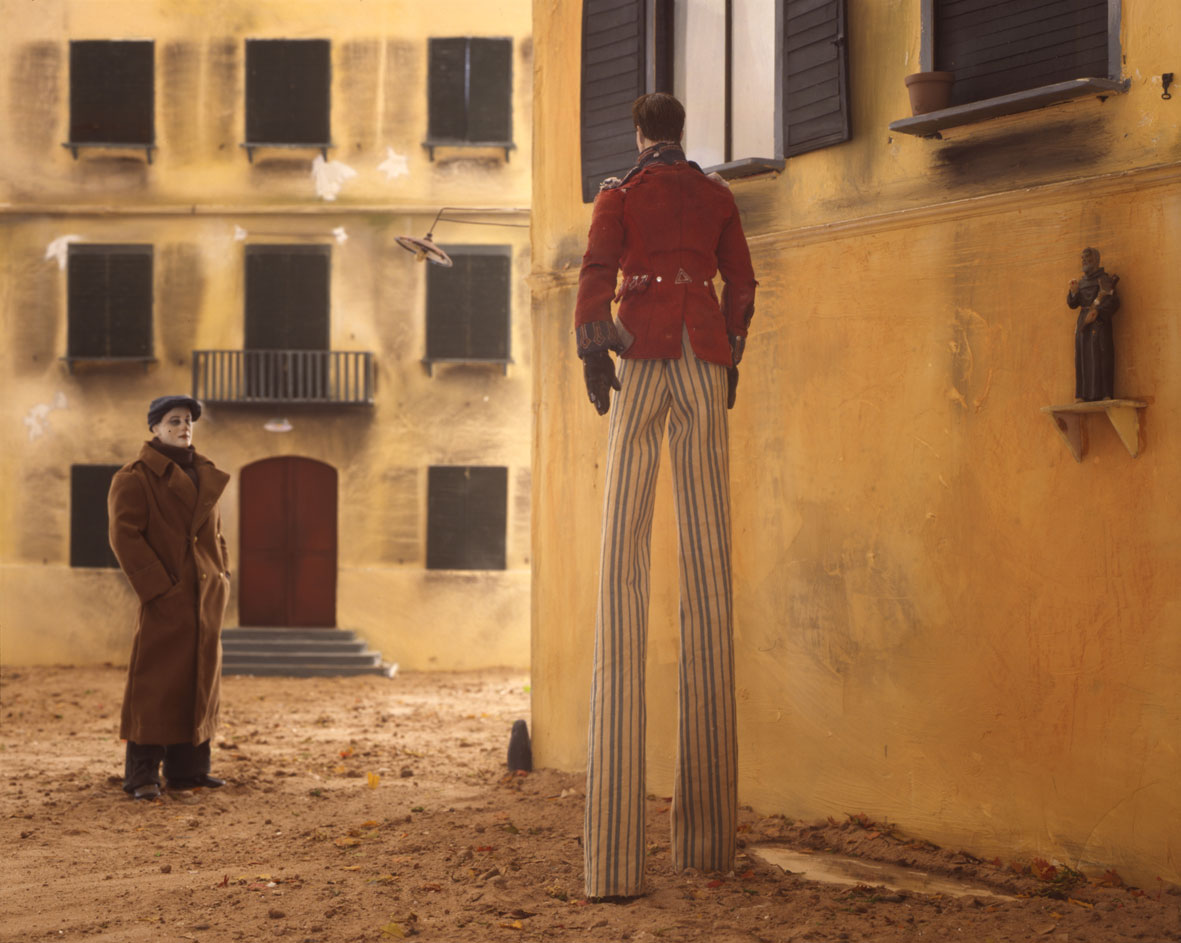
Paolo Ventura was born in Milan, Italy in 1968, now living in New York City. 
He's a photographer whose works are mostly based on model work, resulting in remarkable, unique images that reflect the past, the present, or a kind of personal visions of them. His most known series of images are Behind the Walls, Civil War, The Automaton, War Stories and War Souvenir. Ventura's latest exhibition took place in the Obsolete Gallery, Los Angeles, from February to March 2012, called The Funeral of the Anarchist.
All of Ventura's series contain a lot of (extremely accurately built) historical details, fragments, materials and so called "spirit of the past", that literally makes you able to breath the foggy air of northern italian cities. Nevertheless, authentic documentary of the (italian or european like) past doesn't seem to be the artist's goal in general. It's far more about recreating and imaging his own memories, dreams and realities which are a hybrid of italian past, european atmosphere, and also very contemporary issues like the wars in Iraq and Afghanistan. For him, the past doesn't seem to be something just to be remembered, there's also a chance to manipulate it, reinvent it, or, as he said by himself, "you can really have fun with the past"…

What's the purpose of paintings and photographs?
In my opinion, simply to express more than thousand words ever could. Therefore, Paolo Ventura's work is a perfect example.
Similar to Alan Wolfson's work (I told about him in my previous post), Ventura is inventing worlds. Light and shadow play out in a very precise way in both artists works. To me, Ventura's images seem to be a bit more personal, mainly because there are people involved, human figures that complete and fulfill the special, strange moods.

Surprisingly, Ventura spends only a week to 10 days building the set, at an average cost of around $30. He uses foam board, cardboard, plastic and wood - basically, anything that he can get hold of. Once the set is completed, he takes Polaroids to use as a reference for minor adjustments. He then shoots with a Pentax 6x7 camera from a fixed position, using only natural daylight, preferring to capture the scene on slightly overcast days. In each image, Ventura wants to create his own "fog" and blend the artifice with the "real".

It was quiet tough to select some pictures. Actually you can't extract any of them, because every part of the series belongs to the others. But I hope you'll get a convincing impression of this remarkable artist's work.

www.paoloventura.com 


Behind the Wall (2006)
The Goldfish (featuring Lily Cole, for Vs Magazine, 2011)
The Automaton (2011)
Winter Stories (2009)
Iraq (2008)


February 22, 2012

Big Small Worlds - Alan Wolfson

Why have I always been so interested in artificial, miniature worlds?
Is it about control? Being able to overview every detail of the scene? Creating any perspective you like?
On the other hand, there are so many different types of models. The ones that try to imitate reality in an extremely authentic way, or the works that open another door into a strange, small world, beyond any known everyday reality.
It's the wide space between the familiar authenticity and pure, small sized spatial art, that inspires so many great designers, modelmakers and artists. Watching out for new worlds, by going deep inside.

I'd like to introduce one of them. Brooklyn, NY based Alan Wolfson, who created a range of amazing, precise, urban miniatures, that capture the unique "New York feeling", presenting different situations in subway stations, motel rooms, street corners, etc.


To Atlantic Ave
Paradise Hotel
Moe's Luncheonette
Peepworld
Times Square Hotel Room
Canal Cross Station


February 21, 2012

Soviet Visions - Sculptures

Additionally to the impressive Soviet Constructions I presented before, there are some very fascinating sculptures to be found in several Yugoslavian (former soviet) states as well (now Croatia, Serbia, Slowenia, Bosnia and Herzegowina, etc.). 
The fact that they're 'unmanned' (or 'dead') objects, makes them even more interesting to me in a weird way. History, life, politics, the artist's motivation and efforts, everything that is connected to these works of stone, concrete and metal is getting visible and vivid to me, despite (or because of) this silent, almost morbid loneliness that surrounds them.

I'm always tempted to create my own score for these powerful images in my mind, but at the end, the silence (which must be there I assume) just fits best to them.

Spomenik literally means monument. They were comissioned by former Yugoslavian president Josip Broz Tito in the 1960s and 70s, to honor sites where WWII battles took place or where concentration camps stood. The designers were different sculptors and architects, conveying powerful visual impact to show the strength of the Socialist republic. After the republic dissolved in the early 1990s, they were completely abandoned, and their symbolic meanings were lost.

(All pictures below are taken by Photographer Jan Kempenaers. Released in his book Spomenik: The end of history, in 2010.)
 

Spomenik No. 1 (Podgaric)

Spomenik No. 6 (Kozara)

Spomenik No. 3 (Kosmaj)

Spomenik No. 11 (Nis)

Spomenik No. 8 (Ilirska Bistrica)


February 20, 2012

Soviet Visions - Buildings

I didn't know very much about former Soviet architecture for a long time. 
I was just overwhelmed by H. R. Giger's creations, the legendary extraterrestrial spaceship in Alien, George Lucas' new Worlds and vehicles in the Star Wars saga, etc. The more extraordinary, unusual or strange a building, an interior space, a place or an object in a movie is, the more fascinated i was. Not just in movies, also on posters, paintings or sculptures.
I got a glimpse at one of these, mostly russian, buildings from time to time. But there was one book, Frédéric Chaubin's "Cosmic Communist Constructions Photographed", that really electrified me, when i was browsing an art and design book shop with my girlfriend in London. It opened my eyes and i was just stunned by all these strange, mighty, incredible visions that became reality in several former UdSSR republics.

So, my first issue in this blog will be these silent, lonely giants.
It's very difficult to describe the atmosphere that surrounds them. When I look at them, a lot of other fictional objects, characters, moods and stories are crossing my mind.
At the end, i could just write about these fragments, pieces of dreams or impressions, when I see these buildings and constructions. 


(All pictures below are taken by Photographer Frédéric Chaubin, released in his book CCCP - Cosmic Communist Constructions Photographed, in 2011)

I'd like to share this with you on my blog. Enjoy!


Drzhuba Holiday Center Hall (Ukraine)
Soviet embassy in Havana
Institute of Scientific Research, Kiev
Central Research and Design Institute for Robotics and Technical Cybernetics, St.Petersburg